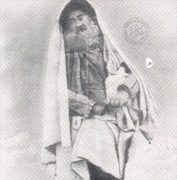
Hacham Moshe Zaqen Mazouz


Hacham Moshe Zaqen Mazouz

Date of Birth: 5611 (1851)
Date of Death: 2nd of Iyar, 5675 (1915)
The Daily Sage, a database of Jewish Spanish sages
A Short Tribute

Hacham Moshe Zaqen Mazouz, son of Kamos, was born in 1851 in Djerba, Tunisia. He learned Torah from Hacham Abraham Hacohen, Hacham Sassi Ma'atuk Cohen Yonatan, and Hacham Haim Hacohen - who would be his principal teacher.

In 1870, Hacham Moshe Zaqen Mazouz was asked to lead community affairs in Djerba's Kebira quarter; he filled this position his entire life.

In 1875, Hacham Moshe Zaqen Mazouz was appointed dayan in Djerba, and in 1905 appointed Av Beit Din – President of the Rabbinic Court.

Hacham Moshe Zaqen Mazouz had numerous students, and the majority of Djerba’s sages of recent generations base themselves on his instruction and Halakhic rulings.

Hacham Moshe Zaqen Mazouz passed away on 2 Iyar, 5675 (1915) and was buried in Djerba. He authored many books, including: Sever Panim – original commentary on Talmud, Sha'arei Moshe – responsa and original Halakhic rulings, Shem Moshe, Tzaddik V'Nisgav – on Tractate Beitza, Vayakhel Moshe – sermons, Kara Moshe – original commentary on Bible and on sayings by ChaZa"L.

A few quotes from the Rabbi on Love of Israel
in which he praises the benefits of unity

Our Sages, of blessed memory, said: The People of Israel can be credited for having fulfilled all the commandments through unity. Since all are as one – what is fulfilled by one is considered as having been fulfilled by the other, and the benefit bestowed by Torah and the observance mitzvoth thus increases. Through unity, one may rejoice when others benefit, or share in their sorrow. It is the equivalent of fulfilling the entire Torah, since to love one's neighbor as oneself is the greatest principle of Torah, as our Sages, of blessed memory, said, as is fulfilling the commandment to “let him (your kinsperson) live by your side” and sustain them. This way there will be no gratuitous hatred, which was the cause behind the exile, and love will replace enmity, for this is what brings the presence of the Shechina.

Unity also helps pursue the truth, for just as we do not want others to be dishonest with us, so will we avoid being dishonest with others, and just as we are willing to share an privilege or a good thing, so do we wish that others share their privilege and good things with us, and vice versa. Unity also protects us from being one of those who profit from the community for the wrong reasons and take only their personal benefit into account. It helps us consider all the People of Israel as though they children of angels – and to appreciate them as we do ourselves.

Hacham Moshe Zaqen Mazouz, VaYakhel Moshe, p. 14, David Idan Press, Djerba, 1916 From 'The Daily Sage'

"It is our custom to light a yahrzeit candle in honor of the memory of the Sages, as it is said: “the life breath of man is the lamp of the Lord” (Proverbs 20:27). And it is good to add from the light of the Torah to the light of the candle, as it is said “For the commandment is a lamp, the teaching is a light” (Proverbs 6:23). And it is good to increase the teaching of the Sage on the anniversary of his death, as Rabbi Yochanan based on the teachings of Rabbi Shimon Bar Yochai said, “Each scholar whose sayings are taught in this world, his lips speak from the grave (Bechorot 31B).”

“Even if all of the skies are a blank parchment, and all human beings are clerks, and all of the forests are quills, we would never be able to write down what our Sages have taught us. But even a few righteous are also good, and thanks to the sacred Torah and the teachings that Israel will learn in the Sage’s name on the anniversary of his death, the Holy One Blessed be He, will share our part with them, and we will never be ashamed because of our faith in the Holy One Blessed be He, and on his great benevolence and truth will we lean, for He hides his abundant goodness for those who are worthy and revere Him.”

The Daily Sage - An online database of Sephardic Jewish Sages

Rabbi Chananaia son of Akashia stated, God wanted to grant merits to Israel, therefore he gave them many laws and commandments as it states, "Because God wants righteousness he increased the amount of Torah and splendor." (Isaiah 42:21).